How Do Pyramids, Mammoths, and Bikini Contests Connect to the End of the Universe?
A Whirlwind Through Time: The Stories That Shape Our Fleeting Moments
Time is a tricky thing. On a small scale, it makes perfect sense with our minutes, hours, and days. But when you stretch it out, it can get pretty overwhelming. Think about your last 24 hours. You probably spent most of it working, sleeping, and possibly wasting a bit too much time online.
Days roll into weeks, weeks into months, and before you know it, years have flown by. Take 2017, for example. In France, eagles were trained to take down terrorist drones. A Czech nuclear power plant picked an intern through a bikini contest. And let’s not forget the ridiculous bleach-eating challenge that went viral. Just typical 21st-century stuff.
A kid born at the start of this century is now 18, but our century is still pretty young. It’s been largely influenced by events like 9/11, which led to wars in Afghanistan and Iraq. The Syrian Civil War started in 2011 and has dragged on since. Most of us were born in the 20th century, a time scarred by two World Wars and the Cold War. For the first time, nuclear weapons had the potential to wipe out humanity, although we also reached the stars and started the internet era, for better or worse.
Think about the lifespan of the average person—around 79 years. The oldest person alive today was born closer to Napoleon’s era than to ours. Just 250 years ago, the Industrial Revolution kicked off, turning farmers into factory workers and spreading knowledge like wildfire, a progress that’s causing climate change today.
Look further back. The Theory of Evolution changed everything. Newton’s theory of gravity came to light. We discovered distant stars and microscopic bacteria. Fast forward to the 15th century—Columbus stumbled upon America, the Middle Ages ended, and the Black Plague decimated Europe. Around 2,000 years ago, our current calendar began, but even then, the world was ancient to the Romans.
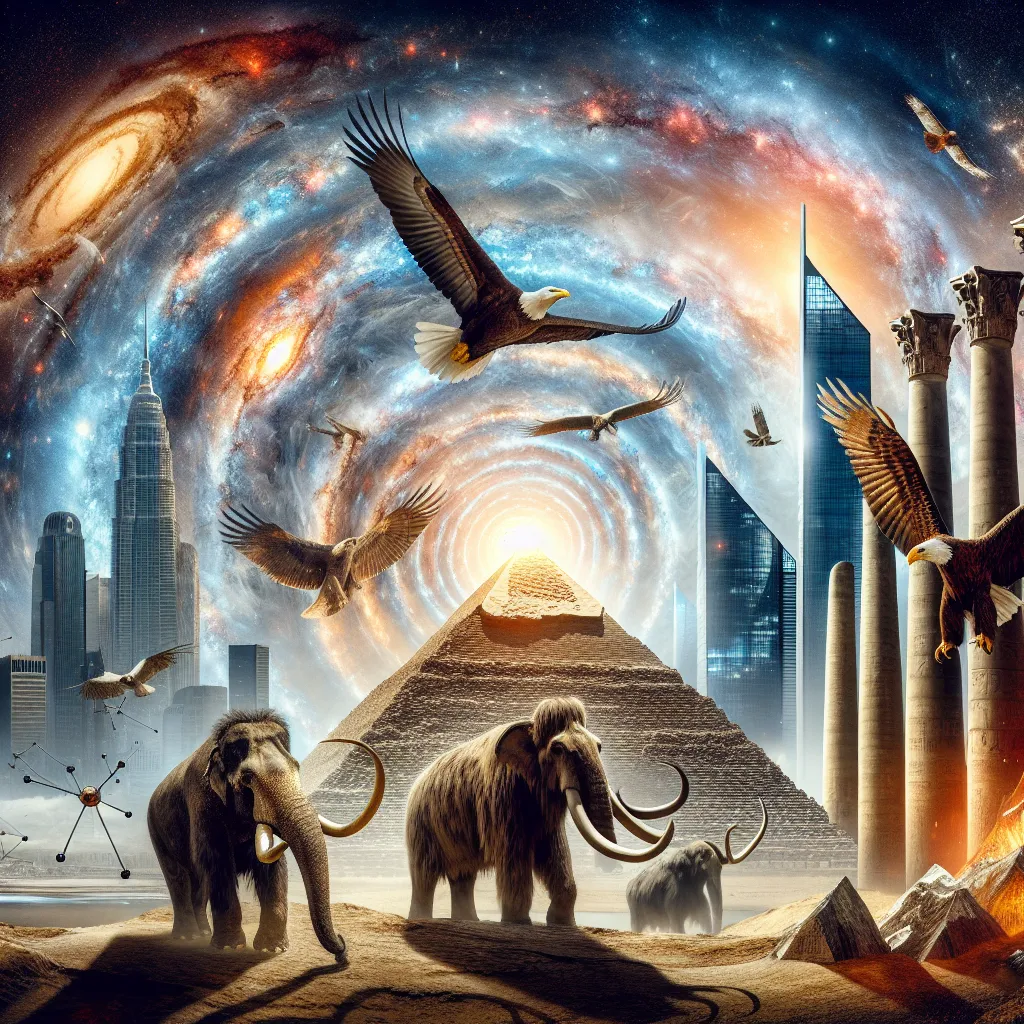
The Great Pyramids were built 4,500 years ago, so they were ancient even to the ancient Romans. There were still mammoths walking the Earth back then. Going further back, 7,000 years ago, humans started writing. About 12,000 years ago, we began farming, which allowed civilizations to grow. Homo sapiens sapiens, or modern humans, appeared about 200,000 years ago, and 50,000 years ago, we had the Cognitive Revolution.
We’re relatively new here; dinosaurs ruled for 165 million years, compared to our short stay. The T-rex from 65 million years ago is actually closer to us in time than it was to the Stegosaurus. Life has been here even longer—about 4.1 billion years ago, it’s thought to have appeared on Earth.
Our solar system is relatively young too. It formed about 4.5 billion years ago, shortly after the sun was born. But zoom out further: The universe is around 13.75 billion years old. What happened before the Big Bang? We don’t know, and we might never know.
Looking ahead, in about 1 billion years, the Sun will become too hot for life on Earth. Four billion years after that, the Sun will die, marking the end of life in this solar system if we haven’t left by then. Over the next 100 billion years, stars will die out, leading to a dark, cold universe in its final stage: Heat death.
It might sound a bit grim, but all of this is far, far in the future. The only time that really matters is now. So, if there’s someone you fancy, ask them out! Time is precious—make the most of it.