Are You Just a Dream in the Universe's Endless Imagination?
The Cosmic Comedy: Contemplating Existence in a Universe of Illusions and Randomness
Imagine if everything you believe about yourself and the universe is just an illusion. You think you exist in a universe born 14 billion years ago, filled with galaxies, stars, and the Earth. But what if none of that is real? It’s possible you might actually be the dream of a dead universe, a product of pure chance.
Let’s break this down and dive into three intriguing concepts to make sense of this mind-boggling idea.
First, let’s talk about the Arrow of Time. If you drop red ink into a glass of water, you’d see it spread but never come together again on its own. Time seems to move in one direction. But on a microscopic level, every motion is random and reversible. The arrow of time exists because it’s statistically more likely for the ink to spread out than to clump together again. In fact, the likelihood of it forming a drop again is so tiny, you’d need to wait a ridiculously long time to see it happen.
Next, consider the distant future of our universe. Born from the Big Bang, it’s expanding faster due to dark energy. Fast forward 100 trillion years, and the last star will die, leaving a universe that grows darker and more empty. Space expands so much it forms a cosmic horizon, beyond which nothing can reach us – not even light. This makes our universe like a giant inside-out black hole. Even this seemingly empty universe won’t be truly empty forever. Quantum effects ensure it would eventually be filled with particles again. With an infinite amount of time, the universe can generate any random collection of particles, much like a monkey hitting random keys on a typewriter.
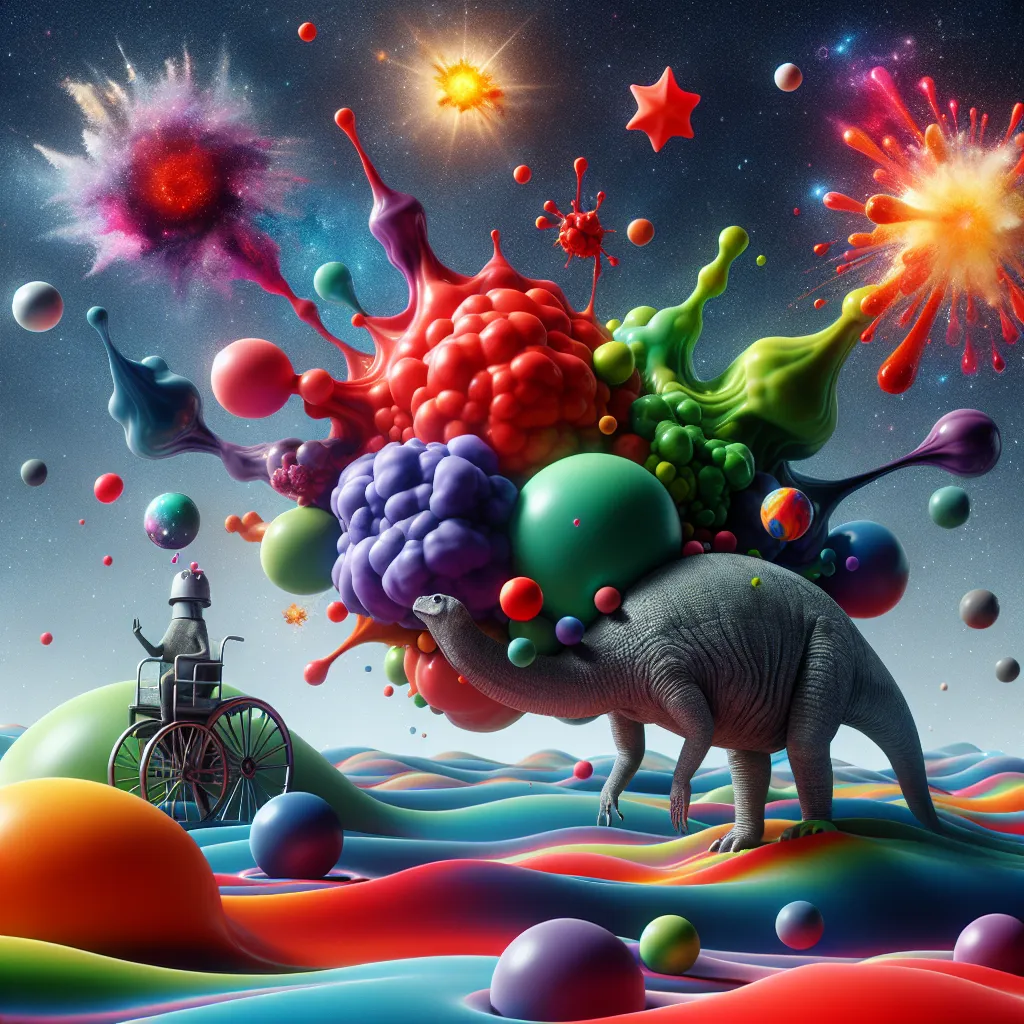
Finally, let’s consider Typing Monkeys and Fake Universes. Given infinite time, every possible arrangement of particles could happen, even forming entire new universes by chance. These “pop-up” universes could be very odd, with random glitches like dinosaurs riding snails or stars made of blueberries. It’s also much more probable that small things, like human brains, could spontaneously form. This leads to the unsettling idea that you might just be one of these random brains, thinking the world around you is real when it’s not.
But don’t lose sleep over this. There are many unknowns about dark energy and the fate of the universe. The laws of physics that suggest you might be a floating brain are also what make the idea questionable. It all circles back to being a fascinating thought experiment demonstrating what science and philosophy can reveal – but it’s nothing to genuinely worry about.
In essence, contemplating such bizarre concepts can help us appreciate the bounds of our knowledge and spur us to ponder deeper questions about existence. While it’s an intriguing theoretical exercise, rest assured, you are most likely a real human living in a real universe.