Are We Really Here, or Just Floating in Space?
Navigating the Infinite Tapestry: Embracing Our Cosmic Dance in the Here and Now
Have you ever just sat and thought about where you are? Not just in a room or a city, but in the universe? It sounds like a silly question, but the idea of having an absolute position is something humans invented. The universe is more like a giant bag of space, filled with things like stars, planets, and black holes. But if we emptied out that bag, what would be left is just space, and in empty space, the idea of a position doesn’t make sense. It’s all the same everywhere.
It’s like standing on a stage but without a floor. You can’t mark a spot or anchor anything because without stuff, there’s no position to mark. Our sense of where we are comes from the things around us. Even “up” and “down” are relative concepts. When you look at the world, it seems flat, and you can move in three dimensions. This is what physicists call a “frame of reference,” which is basically your view and experience of the universe. But this frame is unique to you and isn’t the universal truth.
Zoom out just a bit, and things get weird. About 5 kilometers away, the ground starts to curve away, and gravity starts pulling things not “down” but inward toward Earth’s center. It’s a nifty illusion, really. What feels like a flat plane to us is actually a giant sphere.
But that sphere, Earth, isn’t just sitting still. It’s orbiting the Sun in a messy, elliptical path that changes shape every 100,000 years. The Moon, being a hefty companion, also tugs on Earth, making it jiggle around its orbit. So, you’re on a rotating sphere that’s constantly moving and wiggling around the Sun.
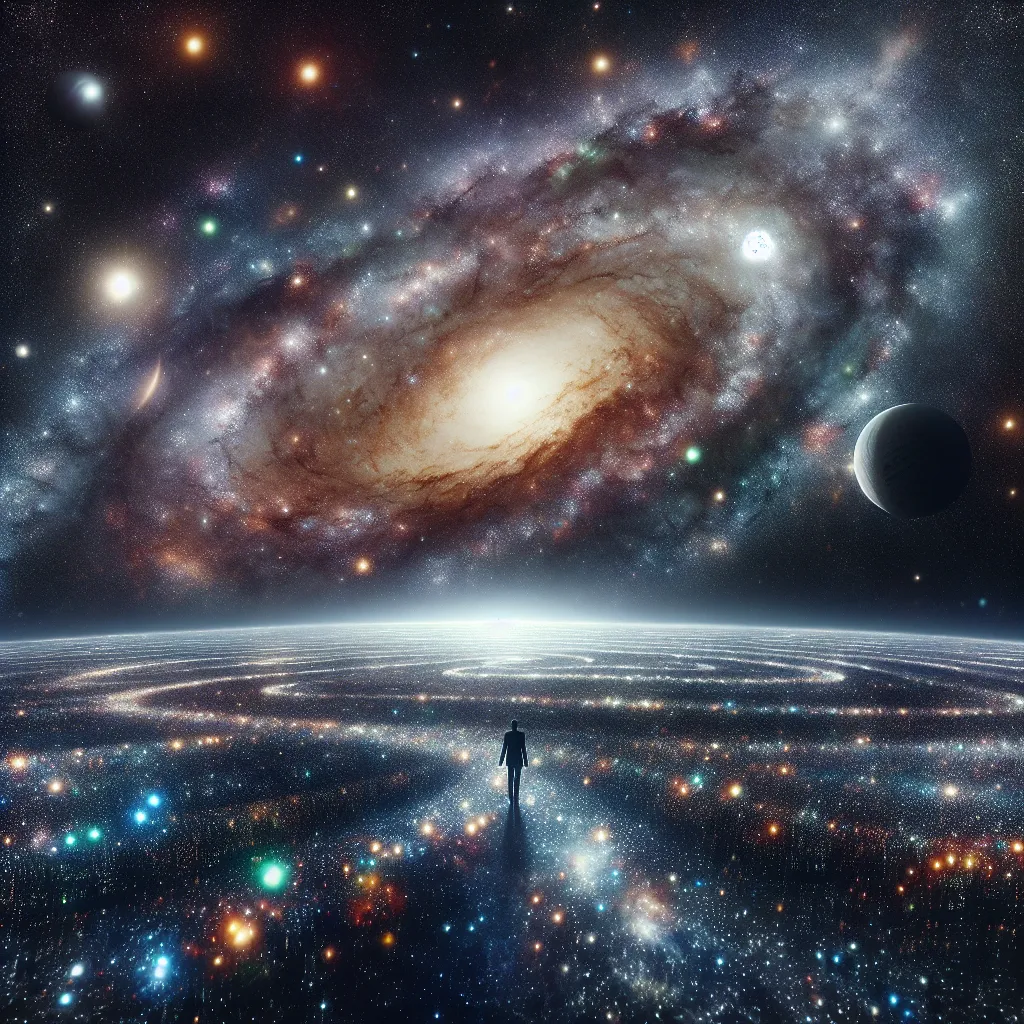
Now, let’s widen the lens more. The Solar System, including Earth, orbits the center of the Milky Way galaxy, but not in a neat plane. Our system is tilted about 60 degrees to the galactic plane and zipping through space at breathtaking speeds. This isn’t just a uniform orbit. Imagine the Solar System moving in a corkscrew motion, diving up and down through the galactic plane like a tipsy dolphin, a journey that takes millions of years, something we humans haven’t even been around long enough to map completely.
Going further out, the Milky Way itself is part of larger cosmic structures like the Laniakea Supercluster and the Pisces-Cetus Supercluster Complex, which are enormous webs stretching across hundreds of millions of light-years. From that kind of distance, everything looks the same.
Trying to comprehend all this can make your head spin. But it doesn’t really change anything about where you are right now. The vastness of the universe is mind-boggling, but it’s also humbling. Despite all the cosmic chaos, you’re at the perfect spot in your own little universe, right here, right now. So, don’t worry about the grand scale of things. Just be present in your own galaxy, your own Solar System, your own Earth. You’re exactly where you need to be.